
On Layered Learning, Narration, and the Quiet Power of Students Becoming Teachers
Lately, I came across a Latin phrase that resonates deeply with me: docendo discimus—by teaching, we learn. It is a simple idea, almost deceptively so, yet it captures something profoundly true about how learning actually takes place. When students teach what they have come to know, something remarkable happens. They rehearse and strengthen their own understanding, while their peers tend to listen more closely and engage more fully. Learning becomes communal, and knowledge taught is, in a sense, knowledge learned twice.
This insight lies at the heart of Classical Christian Education, where learning is intentionally layered and rehearsed through the art of narration. Narration honors something deeply human about the way children learn best—through ownership, voice, and relationship—rather than through passive reception alone. In this model, students are not merely recipients of information but active participants in its formation.
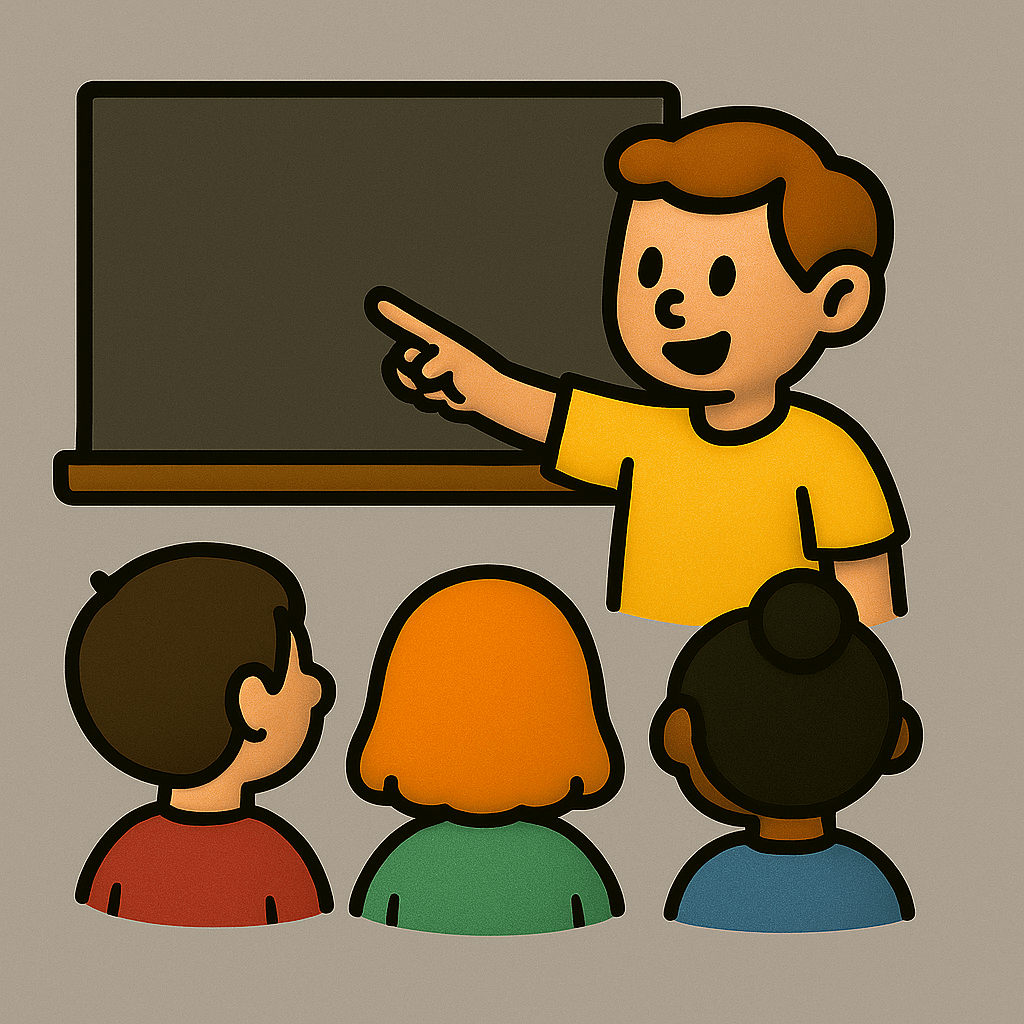
Layered learning begins, as it should, with the teacher. There remains a clear and necessary place for direct instruction, modeling, and intentional guidance. The teacher introduces the material, frames the thinking, and invites students into a shared encounter with knowledge. At the same time, layered learning deliberately moves beyond teacher-centered instruction so that students are gradually invited to carry the weight of learning themselves.
Narration plays a central role in this transition. It is not simply recall, but an act of re-teaching. When students narrate, they reconstruct what they have observed, heard, and understood, putting language to learning. In doing so, they reveal not only what they remember, but how they are organizing ideas internally. Narration, then, becomes thinking made visible, allowing both teacher and student to see understanding take shape.
There is, however, another layer that may be the most transformative of all. After narration, students are given space to reflect. They consider what was clear, what was missing, and how the narration could be improved. This reflective pause invites students to evaluate their own understanding with honesty and care, preparing them for deeper engagement.
Students are then given the opportunity to narrate again, and this re-narration invites refinement. It deepens encoding and strengthens retrieval pathways. What cognitive science confirms—that repeated, effortful recall leads to durable learning—is quietly at work here. Yet for students, the experience feels less like rehearsal and more like growth, as each attempt carries greater clarity, confidence, and insight. Learning becomes something they actively do, not something that merely happens to them.
I have seen this process unfold clearly in my own recent teaching with a small group of children in mental math. At first, my approach was largely teacher-directed and highly structured. I dictated numbers, demonstrated strategies, and guided students step by step, while they responded, practiced, and gradually improved. The structure was effective, but it kept the center of gravity firmly with the teacher.
More recently, I made a subtle shift to invite greater student ownership. Students began taking turns being the “teacher.” They dictated numbers and observed their peers working through the number problems using fingers, mental images, or the abacus. Almost immediately, the atmosphere in the room changed, and the energy of the learning shifted with it.
What emerged was not only stronger mathematical thinking, but leadership. As students stepped into the role of teacher, their understanding was naturally exposed—not in a threatening way, but in an honest one. When a student teaches, misconceptions cannot hide; gaps surface organically. At the same time, confidence grows, and students begin to see themselves as capable and responsible participants in the learning process. This is docendo discimus made visible in real time.
It is important to be clear, however, that when students teach, the teacher does not step aside. Instead, the teacher’s role becomes even more intentional. The teacher observes closely, listens carefully, and assesses quietly, allowing guidance to become more precise and personal. Interventions are timely rather than intrusive, and authority is exercised through attentiveness rather than constant direction.
In this sense, the teacher becomes a true guide—one who shapes the conditions for learning while helping students grow not only in knowledge, but also in responsibility, clarity of thought, and love of learning. The classroom becomes a shared endeavor rather than a one-way exchange.
In a classroom shaped by layered learning and narration, knowledge is not consumed but cultivated. It moves, grows, and becomes shared among students and teacher alike. Perhaps that is why students teaching students does not diminish knowledge at all. Instead, it multiplies it, reminding us that by teaching, we learn—twice.
 Behind the Curriculum Curtain
Leave a comment